
A wide variety of types of radiation occur in nature, such as infrared radiation, visible light, ultraviolet radiation, radiofrequency radiation, low-frequency and static electric and magnetic fields, and ionising radiation. Radioactive substances and X-ray equipment emit ionising radiation.
Types of ionising radiation
Humans are exposed to five types of ionising radiation. Three of these - alpha, beta and gamma radiation - come from naturally occurring or artificially produced radioactive substances; the fourth - X-rays - is produced by processes in the electron shell of stable atoms; and the fifth - neutron radiation - is produced mainly by nuclear fission chain reactions.
In 1895, Wilhelm Conrad Röntgen discovered the so-called x-rays, which were later called X-rays. A year later, Henry Becquerel discovered natural radioactivity while studying uranium salt. The work of Marie and Pierre Curie and the discovery of Ernst Rutherford showed that a magnetic field separates radioactive radiation from radium into three components: alpha, beta and gamma radiation.
Radionuclide half-life
Each radionuclide has its own average lifetime, expressed as half-life. The half-life is the time it takes for half of the original number of radionuclides to decay. Half-lives vary widely, ranging from a thousandth of a second to billions of years. The nuclear decay rate of a substance is called its activity. The unit of activity is the becrell (Bq), which corresponds to one nuclear decay per second.
The effect of radiation on a substance is measured by radiation dose. The unit of measurement for the whole-body dose to the human body, or effective dose, is the Sv, and micro- and millisieverts are used in practical dose calculations.
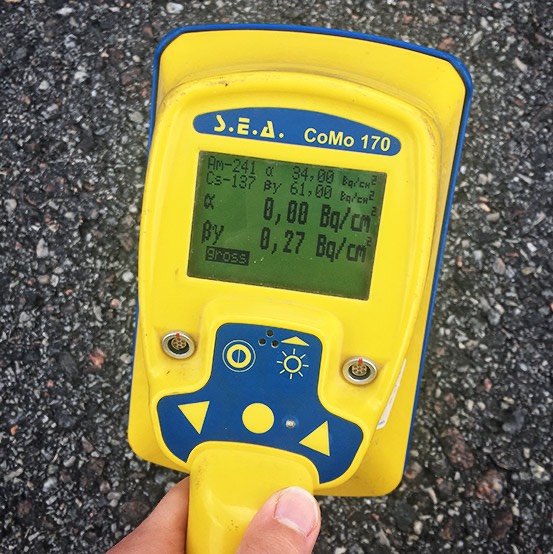
Sources of ionising radiation
All organisms receive a constant dose of radiation, and this dose comes from five main sources:
- From the Sun and the cosmos from cosmic rays (~10%);
- natural radionuclides (~10%) in the crust;
- gaseous radon (~65%) from the decay of naturally occurring radioactive elements;
- radioactive elements (~13%) in the organism;
- from artificial radiation sources (~2%).
The average annual radiation dose to the Estonian population is about 2.5 mSv.
Effects of ionising radiation
Ionising radiation damages living cells by generating extremely reactive free radicals. The more radiation the human body receives, the more the cells are damaged. A single high dose of radiation (500 mSv or more) can cause damage to health within a few days, for example reddening of the skin, nausea and vomiting. A dose of 3,000 mSv can kill half of the population within a few weeks. Low doses may not cause immediate damage but increase the likelihood of developing tumours and hereditary diseases.
Radiological emergency
In Estonia, the most likely sources of radiological threat are:
- nuclear power plants in neighbouring countries - Loviisa in Finland, Sosnovy Bor in Russia and Ignalina in Lithuania;
- radioactive waste management;
- an accident involving a lorry carrying radioactive material;
- failure to comply with safety requirements when working with a radiation source.
In the case of radioactive environmental contamination, a person can receive external exposure from radionuclides in the air or deposited on the ground, and internal exposure from radionuclides in the body through inhalation, contaminated food or water.
The Rescue Board, which is also the lead authority in organising the protection of the population, informs the public about radiation emergencies in Estonia. The Radiation Centre in particular receives warning information about radiation emergencies in other countries, and is also responsible for monitoring the levels of radioactivity in the atmosphere throughout Estonia around the clock and alerting the Rescue Board to possible clouds of contamination.
It is important to know how to protect yourself from radioactive radiation. In the event of a radiation emergency, there are principles to follow:
- the shorter the exposure time, the lower the dose;
- the further away you are from the radiation source, the lower the dose;
- the dose is reduced by any shielding;
- when in a radioactively contaminated area, respiratory and skin must be protected;
- no eating, drinking or smoking in the contaminated area.
If you find an object with a radiological mark, you should immediately move away from it and report it to the emergency number 112 or to the Environmental Inspectorate's hotline 1313. You should also report the find if you cannot see the mark but suspect that it may be a radiation source.
Radiation safety and radiation protection
Radiation law According to § 4, a radiological practice is any activity that increases or may increase human exposure to artificial or natural radiation sources. Exposure activities are, inter alia:
- the production, processing, use, possession, storage, transport, including import and export, and intermediate and final storage of radioactive material;
- the use of electrical equipment emitting ionising radiation and operating at a potential difference greater than 5 kV;
- operation of a nuclear installation.
According to §§ 21-23 of the Radiation Act, the principles of radiation safety are:
- The proposed practice must be justified by demonstrating that it is the best in terms of the economic, social or other benefits in relation to the potential health damage caused by the practice.
- Any acceleration must be kept to a minimum, as far as reasonably possible taking into account economic and social factors.
- The sum of the doses to be received in the course of irradiation shall not exceed the limits established under this Act. This requirement shall not apply to medical and emergency exposure.
ALARA principle - levels of ionising radiation must be kept as low as reasonably achievable without harming human life and health and the surrounding environment.
Radioactive waste management principles
The International Atomic Energy Agency (IAEA) document „The Principles of Radioactive Waste Management“, Safety Series No 111-F, IAEA, Vienna, 1995, the principles of radioactive waste management are:
- Protecting human health. Radioactive waste is managed in a way that ensures an acceptable level of protection of human health.
- Environmental protection. Radioactive waste will be managed in a way that ensures an acceptable level of environmental protection.
- Cross-border protection. Radioactive waste will be managed in a way that ensures that potential transboundary effects on human health and the environment in neighbouring countries are also taken into account.
- Protecting future generations. Radioactive waste will be managed in such a way that the foreseeable effects on the health of future generations do not exceed today's acceptable levels.
- The burden on future generations. Radioactive waste will be managed in a way that does not place an excessive burden on future generations.
- National legislation. Radioactive waste is managed in accordance with the legislation. Legislation must, inter alia, ensure a clear division of responsibilities and independent regulatory functions.
- Control of the generation of radioactive waste. The generation of radioactive waste is kept to a minimum as far as is practicable.
- Interdependence between radioactive waste generation and management. All interdependencies between all stages of radioactive waste generation and management must be taken into account.
- Safety of facilities. The safety of radioactive waste management facilities shall be ensured throughout their lifetime.
It is therefore important to consider the effects of radioactive radiation on people and the environment and to prevent the harmful effects of radioactive radiation.