
Radiation monitoring allows us to continuously monitor the levels of radioactivity and assess its effects so that we can make informed decisions to ensure the protection of both human health and the environment.
Release of radionuclides into the environment
Radiation inevitably releases radionuclides into the surrounding aquatic and aerial environment. In the worst case, this is an emergency release, but usually it is a so-called 'radiological release'. In the worst case, however, they are mostly controlled releases, where a certain amount of radionuclides is released into the air or discharged through the sewage system into a surrounding water body. It is neither possible nor sensible to apply for 100%list treatment of emissions if the resources expended do not outweigh the environmental and health benefits for the population.
Radionuclide source monitoring
With controlled emissions, it is natural that there will be a so-called. ”source monitoring” (ingl. source monitoring), which determines the total amount and activity of radionuclides released into the environment at the point of release (stack, sewer, collector, etc.) and compares the results with regulatory reference values. The maximum permissible quantities of radionuclides in radioactive discharges currently in force in Estonia are given here. Since the establishment of ALARA and the monitoring carried out by the company, no exceedances of the above mentioned reference levels have been recorded at the former Paldiski nuclear site and the Tammiku radioactive waste repository.
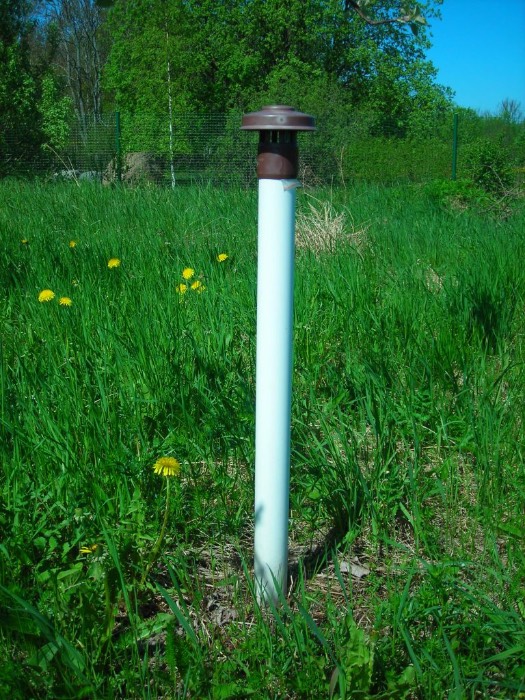
Radiation monitoring in the environment
To ensure the protection of the environment and the general public, it is also important to monitor radionuclide concentrations and behaviour in the water, air and food chains surrounding the former Paldiski nuclear site. The design of the radiation monitoring programme for this purpose should take into account the nature of the nuclear installation and its releases, the parameters of the surrounding environment (vegetation, precipitation, geological and hydrogeological conditions) and the local population and their habits. The data collected during radiation monitoring can be used to make safety assessments, which can be used as a basis for planning and implementing preventive measures.
Of the sites managed by ALARA, a limited amount of liquid effluents are currently generated only at the Paldiski site and are mainly related to the washing of contaminated private clothing. However, in addition to the impact of modern discharges, the Paldiski and Tammiku environments certainly still reflect traces of the sites' past history. This is confirmed by the presence of tritium in groundwater samples taken from monitoring wells at both the Tammiku and Paldiski sites.
Measurement results of environmental monitoring of the former Paldiski nuclear site
The monitoring plan for the Paldiski site is in accordance with the Radiation Activity Licence and the Environmental Permit for Special Use of Water and consists of monitoring of groundwater, waste water, total background gamma radiation (TLD), drinking water, soil and grass.
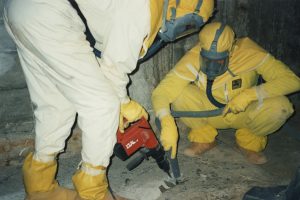
Environmental monitoring results for the Tammiku radioactive waste repository
The monitoring plan for the Tammiku site is in accordance with the radiological permit and consists of groundwater, total gamma background (TLD), soil and grass monitoring. The monitoring will be carried out simultaneously on the site of the repository and its immediate surroundings, as well as on a more distant reference area.
Monitoring plans
Monitoring plan for the Paldiski site from 02.07.2019. a.
| Sample type | Location, sample point | Frequency | Analytical programme |
|---|---|---|---|
| Upper aquifer | Drill holes PA1, PA6, PA9 | 1 x quarterly | H-3, gamma-ray spectrometry (Co-60 and Cs-137), Sr-90.1 |
| TLD | 3 locations on the perimeter of the object, TLD1, TLD2 and TLD4 | 1 x per month | Overall gamma radiation background |
| Discharge outside the object | A kissing place on the coast | 1 x quarterly 1 x within 6 months2 | H-3, gamma-ray spectrometry (Co-60 and Cs-137), Sr-90.1, chelium, BHT-7, KHT, N-side, P-side, petroleum products, pHFluoride (F), mercury (Hg), arsenic (As), barium (Ba), cadmium (Cd), chromium (Cr), nickel (Ni), lead (Pb), zinc (Zn), copper (Cu), tin (Sn)), mono- and di-phenols. |
| Raw | 3 locations near the main building, R1 - R3 | 1 x within 6 months | Gamma spectrometry (Co-60 and Cs-137), Sr-901 |
| Drinking water | Paldiski site water supply | 1 x per year | H-3, gamma-ray spectrometry (Co-60 and Cs-137), Sr-90. |
| Soil (5 cm thick) | 3 locations near the main building, R1 - R3 | 1 x per year | Gamma spectrometry (Co-60 and Cs-137), Sr-90 |
Notes:
1 - The Sr-90 activity concentration is determined once a year (4 quarters) from a pooled sample.
2 - monitoring of hazardous substances will be carried out in the years 2019-2021. If no hazardous substances are present in these years, only general indicators of pollution will be monitored in the future (chelated substances, BHT-7, KHT, N-saturation, P-saturation, petroleum products, pH).
Monitoring plan for the Tammiku site from 01.03.2018. a.
(a) The territory of the Tammiku radioactive waste repository and its surroundings.
| Sample type | Location, sample point | Frequency | Analytical programme |
|---|---|---|---|
| Upper aquifer | South of the reservoir, borehole T-PA | 1 x quarterly | H-3, Cs-137, Sr-90, Ra-226, Am-241 |
| Raw | 1 location, R4 | 1 x within 6 months | Cs-137, Sr-90 |
| Soil (0-10 cm) + gamma phonon | 4 locations, P2, P4, P6 and R4 | 1 x per year | Cs-137, Sr-90, Ra-226, Am-241 |
| TLD | 1 location, TLD10 | 1 x quarterly | Overall gamma radiation background |
b) Comparison of land area
| Sample type | Location, sample point | Frequency | Analytical programme |
|---|---|---|---|
| Soil (0-10 cm) | 8 locations, Tref1 - Tref8 | 1 x per year | Cs-137, Sr-90, Ra-226, Am-241 |
The annual environmental ionising radiation monitoring reports of the Environmental Protection Agency, which include, among others, the results of the monitoring of the natural environment in the vicinity of the AS sites (Paldiski and Tammiku) and the HELCOM marine environment, are available:
https://keskkonnaamet.ee/keskkonnakasutus-keskkonnatasu/kiirgus/kiirgusseire-ja-kriisireguleerimine#kiirgusseire-aruande
More reading:
IAEA Safety guide
“Environmental and Source Monitoring for Purpose of Radiation Protection”